
Short answer: sunlight contains every color. Air molecules scatter short wavelengths (blue and violet) far more than long ones (orange and red). When the sun is low, its light crosses up to about 38 times more air than at noon. By the time it reaches you, almost all the blue has been scattered out of the beam, and what’s left is mostly orange and red.
That’s the core of it. But the full story has a few twists, including one you’ve probably heard backwards: pollution doesn’t make sunsets more colorful. It usually makes them duller.
The same physics makes the sky blue and the sunset red
Sunlight looks white because it mixes every color of the rainbow. When that light hits nitrogen and oxygen molecules in the air, a small part of it is knocked off course. This is called Rayleigh scattering, and it has one key rule: the shorter the wavelength, the more it scatters. The strength goes up with the inverse fourth power of the wavelength.
In plain numbers, light at 425 nanometers (blue) scatters about 5.5 times more than light at 650 nanometers (red). The ratio is (650 ÷ 425)⁴.
So at midday, blue light gets scattered all over the sky and reaches your eyes from every direction. That’s why the daytime sky looks blue, as the UK Met Office explains. The direct beam from the sun loses only a little blue on its short trip down, so the sun itself looks white or pale yellow.
At sunset, the same process runs much longer.
The low sun’s light takes a very long road
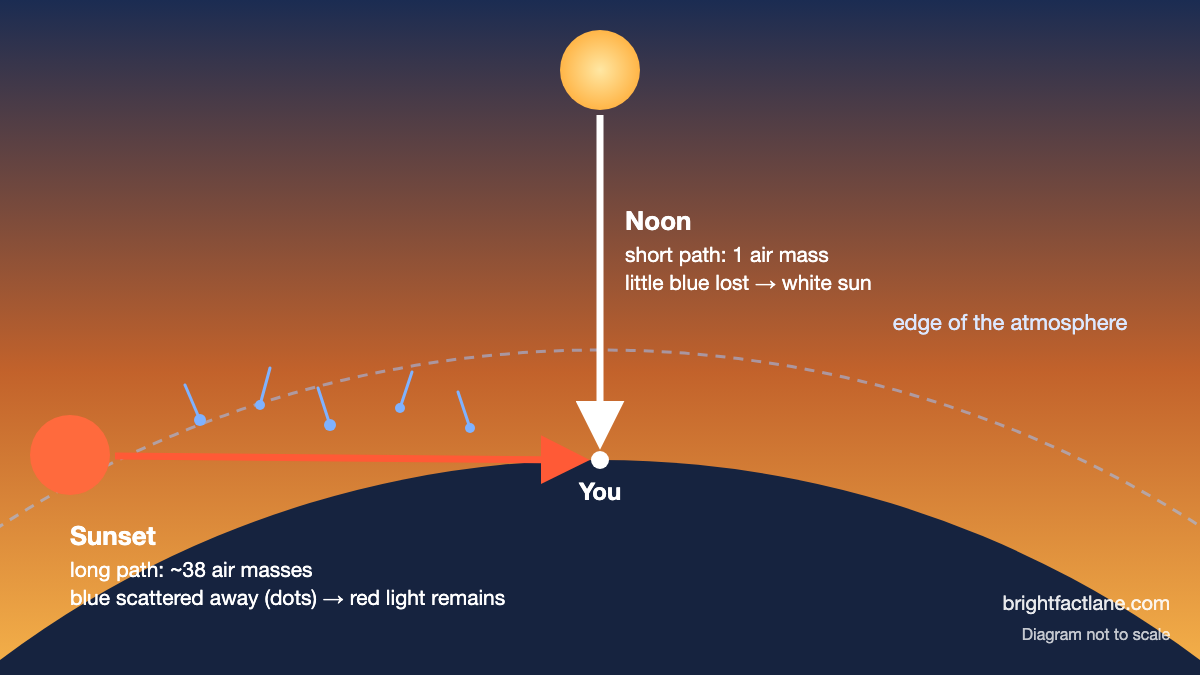
When the sun is overhead, its light passes through the atmosphere by the shortest route. Astronomers call that thickness “one air mass.” As the sun sinks, the path gets longer and longer. At the horizon, sunlight travels through roughly 38 air masses at sea level. That value comes from the standard air-mass formula published by Kasten and Young in Applied Optics (1989).
Every extra air mass is another chance for blue light to be scattered out of the beam. The table below shows what that does to each color.
How much of each color survives the trip
We calculated how much blue, green and red light from the direct sunbeam reaches the ground in perfectly clean air at sea level. We used the Kasten–Young air-mass formula and standard Rayleigh optical depths for a molecular atmosphere (about 0.145 at 500 nm per the American Meteorological Society, scaled with the λ⁻⁴ law).
| Sun height above horizon | Air masses crossed | Blue (450 nm) reaching you | Green (550 nm) | Red (650 nm) | Red vs. blue |
|---|---|---|---|---|---|
| 90° (overhead) | 1.0 | 80% | 91% | 95% | 1.2× |
| 30° | 2.0 | 64% | 82% | 90% | 1.4× |
| 10° | 5.6 | 29% | 58% | 75% | 2.6× |
| 5° | 10.3 | 10% | 36% | 59% | 5.8× |
| 2° | 19.4 | 1.4% | 15% | 37% | 27× |
| 1° | 26.3 | 0.3% | 7% | 26% | 88× |
| 0° (on the horizon) | 37.9 | ~0% | 2% | 15% | 600×+ |
Calculation by Bright Fact Lane. Clean, dry air only. Real air also contains dust, smoke, water droplets and ozone, which dim all colors further.
Two things stand out:
- The change is sudden at the end. Between 10° and 2° above the horizon, which takes roughly 30 to 45 minutes at mid-latitudes, the surviving blue drops from about a third to almost nothing. That’s why the sky seems to “switch on” its color in the last minutes before sunset.
- Green drops out too. By the time the sun touches the horizon, even green is mostly gone. That leaves the deep orange and red you see right at sundown.
Why the whole sky glows, not just the sun
The direct sunbeam turns red, but the colors spread across the sky because that reddened light lights up everything it touches on its way: clouds, haze, and the air itself.
Clouds are the best screens. High, thin clouds like cirrus sit 6 km (about 4 miles) or more up. They stay in sunlight several minutes after the sun has set for you on the ground. As PBS NOVA notes, they catch the last red-orange rays and reflect them back down. That’s why the most spectacular sunsets often come with a scattered layer of high clouds, not a clear sky and not a solid overcast.
The pollution myth: dirty air makes duller sunsets
You may have heard that smog, dust or city haze creates the most colorful sunsets. Meteorologist Stephen Corfidi of NOAA’s Storm Prediction Center argues the opposite in his essay The Science of Sunsets.
The particles in ordinary haze are much bigger than air molecules, roughly 0.5 to 1 micrometer across. They scatter all colors about equally, so they don’t sort light into blues and reds. Instead they wash everything toward a milky white-gray and dim the light reaching the ground. Corfidi points out that if haze made brilliant sunsets, big polluted cities like Los Angeles, London or Mexico City would be famous for them. They aren’t.
The most vivid sunsets come from clean air near the ground. That’s one reason many people find fall and winter sunsets more striking: summer heat and sunlight speed up the chemistry that forms haze.
There’s one real exception: big volcanic eruptions. They inject sulfur gases into the stratosphere, 15 km (9 miles) or more up, where these form a thin veil of tiny droplets that can last for months. That high layer catches sunlight after sunset and adds blue scattered light to the red, creating purple twilights. After the 1991 eruption of Mount Pinatubo in the Philippines, observers in many countries reported vivid, purple-tinged twilights that lasted for months, as Sky & Telescope has described.
If blue scatters more, why isn’t the sky violet?
Violet light scatters even more than blue, so this is a fair question. Part of the answer is that sunlight contains somewhat less violet than blue. The bigger part is our eyes. Human color vision is much less sensitive at violet wavelengths, and the mix of blue and violet in skylight registers to our cone cells as a pale blue. Science News explains why physicists still argue about the exact share of each factor.
Try it yourself: a sunset in a glass
You can recreate this at home in two minutes:
- Fill a clear glass or a straight-sided jar with water.
- Stir in a few drops of milk. Start with very little, because tiny milk particles act like the scatterers in air.
- In a dark room, shine a flashlight (a white LED phone light works) through the side of the glass.
- Look at the glass from the side: it has a faint bluish tint, the “daytime sky.”
- Now look through the glass toward the light: the beam looks yellow-orange, the “sunset.”
- Add a few more drops of milk. The beam turns deeper orange, like the sun sinking lower and its light crossing more air.
If you add too much milk, everything goes white and murky. That’s the haze effect from the pollution section: too many large particles wash the colors out.
Frequently asked questions
Are sunrises less colorful than sunsets?
Physically, the light takes the same long path at both ends of the day. Differences come from the air itself. Evenings often carry more dust and haze stirred up during the day, while early mornings are often calmer and cleaner, so sunrise colors can be crisper. It depends on local weather, not on the sun.
Why is the sun itself red when it’s on the horizon?
For the same reason as the sky: its direct light has crossed about 38 air masses, and almost all of the blue and much of the green has been scattered out along the way. The table above shows that only red keeps a meaningful share.
What’s the “green flash”?
Right as the sun disappears, the atmosphere bends (refracts) colors slightly differently, so the top edge of the sun can flash green for a second or two. You need a clear, flat horizon like the ocean to see it.
Does wildfire smoke make sunsets redder?
Smoke particles are larger than air molecules, so heavy smoke mostly dims the sky and turns the sun into a dull red or orange disk. The surrounding sky often turns gray or brown rather than vivid. Light smoke far away can tint the sun deep red without much color in the sky around it.
Sources
- UK Met Office, “Why is the sky blue?”
- Kasten, F. & Young, A. T. (1989). “Revised optical air mass tables and approximation formula.” Applied Optics, 28(22), 4735–4738.
- Bucholtz, A. (1995). “Rayleigh-scattering calculations for the terrestrial atmosphere.” Applied Optics, 34(15), 2765–2773.
- American Meteorological Society, Glossary of Meteorology, “Rayleigh optical depth.”
- Corfidi, S. F., NOAA Storm Prediction Center, “The Science of Sunsets.”
- PBS NOVA, “Why the Sky Changes Colors at Sunset.”
- Sky & Telescope, “Volcanoes Turn Twilights Purple.”
- Science News, “Why isn’t the sky violet, Daddy?”