
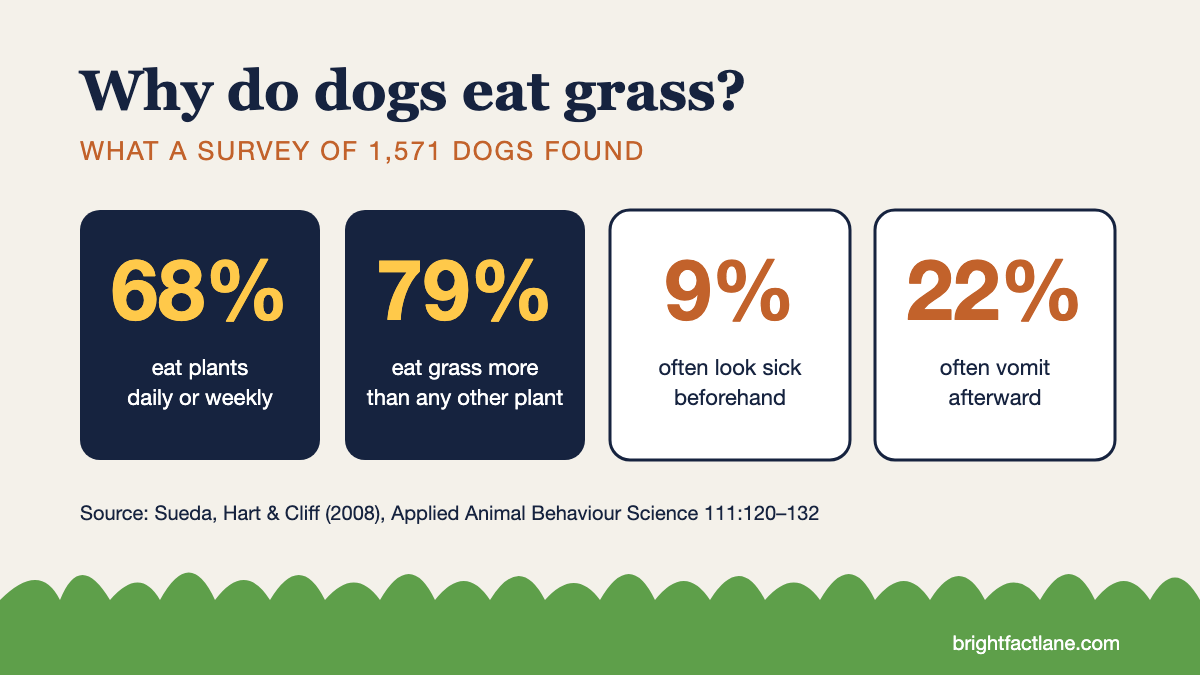
Short answer: for most dogs, eating grass is normal behavior, not a sign of illness. In the largest study on the subject, 1,571 dog owners reported that grass was the plant their dogs ate most often. Only 9% of those dogs regularly looked sick beforehand, and only 22% regularly vomited afterward. Scientists’ best explanation is that the habit is inherited from wild ancestors, possibly as a way to help clear intestinal parasites, though nobody has proven it yet.
So if your dog grazes on the lawn and then trots off happily, that’s typical. Below is what the research found, the myths it busted, and the few situations where grass eating does deserve a call to your vet.
What the studies actually found
Grass eating is one of the most common questions vets and behaviorists get, but it has been studied surprisingly little. Three pieces of research do most of the work:
| Study | Dogs | Key finding |
|---|---|---|
| UC Davis clinic survey (Sueda, Hart & Cliff, 2008) | 47 healthy dogs with daily access to plants | 79% had eaten grass or other plants |
| UC Davis online survey (same paper) | 1,571 plant-eating dogs (from 3,340 responses) | 68% ate plants daily or weekly; grass was the plant 79% ate most often; only 9% often seemed ill before and 22% often vomited after |
| University of New England, Australia (Bjone, Brown & Price, 2007) | 12 dogs observed with free access to grass | Dogs ate more grass before meals than after, and less as the day went on |
The UC Davis team also found that grass eating had no link to a dog’s sex, whether it was spayed or neutered, its breed group, or its type of diet. The one factor that mattered was age: younger dogs ate plants more often, and they were less likely to look sick before or vomit after.
That pattern is hard to square with the idea that dogs eat grass because they feel unwell. If they did, sick-looking dogs and vomiting would be the rule, not the exception.
Myth vs. fact
| Common belief | What the evidence says |
|---|---|
| “Dogs eat grass to make themselves throw up.” | Only about 1 in 5 grass-eating dogs regularly vomits afterward (22% in the UC Davis survey). Most eat grass and keep it down. |
| “Grass eating means my dog is sick.” | Only 9% regularly looked ill before eating plants. Healthy, young dogs did it the most. |
| “My dog is missing fiber or nutrients.” | Diet type (commercial, home-cooked or raw) made no difference in how often dogs ate plants. A diet gap hasn’t been ruled out completely, but there’s no good evidence for it. |
| “Only bored dogs eat grass.” | Boredom may play a part for some dogs, but dogs in the studies ate grass across all lifestyles. The Australian study tied it more to hunger and time of day. |
So why do they do it? The leading explanations
1. It’s an inherited, ancestral behavior
Wild canids such as wolves eat some plant material too. A review of wolf diet studies in the British Journal of Nutrition found that, where it was measured, plant matter made up only about 0.1% to 3% of what wolves ate by weight. That’s small, but it’s there, and grass often shows up in their scat.
The UC Davis researchers think this points to an old survival habit. As far back as 1944, a biologist studying wolves recorded intestinal worms wrapped around blades of grass in wolf droppings. Wild chimpanzees do something similar: they swallow rough, whole leaves, especially in seasons when parasite risk is high, and those leaves have been seen leaving the gut along with worms.
The theory is that undigested grass speeds up the gut and physically sweeps parasites out. It also fits the age pattern: young canids carry more intestinal parasites than adults, and young dogs are the most frequent grass eaters. It’s still a hypothesis, though. No controlled study has yet tested whether grass actually reduces worms in dogs, and modern dogs on regular dewormers keep the habit anyway.
2. Hunger and timing
In the Australian study, dogs ate noticeably more grass before their meal than after it, and grazing tapered off through the day. A full dog was less interested in the lawn. That suggests grass eating is partly a foraging behavior that switches on with an empty stomach.
3. They like it, and they learn it
Many dogs seem to simply enjoy fresh grass, especially new spring growth. The same University of New England group also studied whether puppies pick the habit up from their mothers, which would help explain why some dogs graze far more than others.
Normal grazing vs. a reason to call your vet
Use this as a quick guide. When in doubt, ask your veterinarian, who knows your dog’s history.
| Usually normal | Talk to your vet |
|---|---|
| Your dog nibbles grass and acts normal afterward | Grass eating is new, sudden or frantic, like gulping grass urgently |
| Occasional vomiting right after, then back to normal | Repeated vomiting, retching without bringing anything up, or a swollen belly (get help right away) |
| A young dog that has always grazed a bit | Diarrhea, blood in vomit or stool, lethargy, or not eating |
| Grass seen passing through in the stool | Weight loss, or eating non-food items like dirt, fabric or plastic |
| Eating grass in your own untreated yard | Your dog ate plants or grass that may have been treated with chemicals, or a plant you can’t identify |
Keeping grass eating safe
The grass itself is rarely the problem. What’s on it, or growing next to it, can be.
- Watch for lawn treatments. Fertilizers, herbicides, insecticides and especially snail and slug baits can be dangerous. Keep your dog off treated areas for as long as the product label says, and be careful in parks and neighbors’ yards, where you don’t know what’s been applied.
- Know the toxic plants. Many common garden and house plants are poisonous to dogs. The ASPCA keeps a searchable list of toxic and non-toxic plants.
- Keep parasite prevention up to date. Grass and soil can carry parasite eggs from other animals’ droppings, which is a good reason to stay on your vet’s deworming schedule.
- Offer a safe patch. If your dog loves to graze, a pot of untreated grass (wheatgrass or oat grass) gives a safe outlet.
- Feed on a steady schedule. Since hungry dogs graze more, regular meals may reduce how much grass your dog eats.
If you think your dog ate something toxic, call your vet or the ASPCA Animal Poison Control Center at (888) 426-4435 right away. A consultation fee may apply.
Frequently asked questions
Is it OK to let my dog eat grass?
For a healthy dog eating untreated grass, an occasional graze is generally considered normal. The bigger risks are chemicals, toxic plants and parasites, not the grass itself.
Why does my dog eat grass and then throw up?
It happens, but less often than most people think: about 22% of grass-eating dogs regularly vomit afterward. Grass can tickle the throat and stomach lining. Researchers also couldn’t explain why dogs on commercial diets were somewhat more likely to vomit after eating plants than dogs on home-cooked or raw diets. If vomiting is frequent or your dog seems unwell, see your vet.
Why does my dog eat grass frantically?
Sudden, urgent grass gulping that’s out of character for your dog is worth a vet check, especially with drooling, retching or a bloated belly. It can be a sign of stomach upset that needs attention.
Do puppies eat more grass than older dogs?
Yes. In the UC Davis survey, younger dogs ate plants more often than older dogs, and they were less likely to seem sick before or vomit after.
Should I stop my dog from eating grass?
You don’t need to stop normal grazing. Focus on making it safe: avoid treated lawns, learn the toxic plants in your area, and keep up with parasite prevention.
This article is for general information and isn’t a substitute for advice from your veterinarian.
Sources
- Sueda, K. L. C., Hart, B. L., & Cliff, K. D. (2008). “Characterisation of plant eating in dogs.” Applied Animal Behaviour Science, 111(1–2), 120–132.
- Bjone, S. J., Brown, W. Y., & Price, I. R. (2007). “Grass eating patterns in the domestic dog, Canis familiaris.” Recent Advances in Animal Nutrition in Australia, 16, 45–49.
- University of New England, “Maternal influence on grass eating behavior in puppies.”
- Bosch, G., Hagen-Plantinga, E. A., & Hendriks, W. H. (2015). “Dietary nutrient profiles of wild wolves: insights for optimal dog nutrition?” British Journal of Nutrition, 113(S1), S40–S54.
- ASPCA, “Toxic and Non-Toxic Plants List.”
- ASPCA, “Animal Poison Control Center.”